Memory-Distilled Selection for Noise-Robust Anomaly Detection
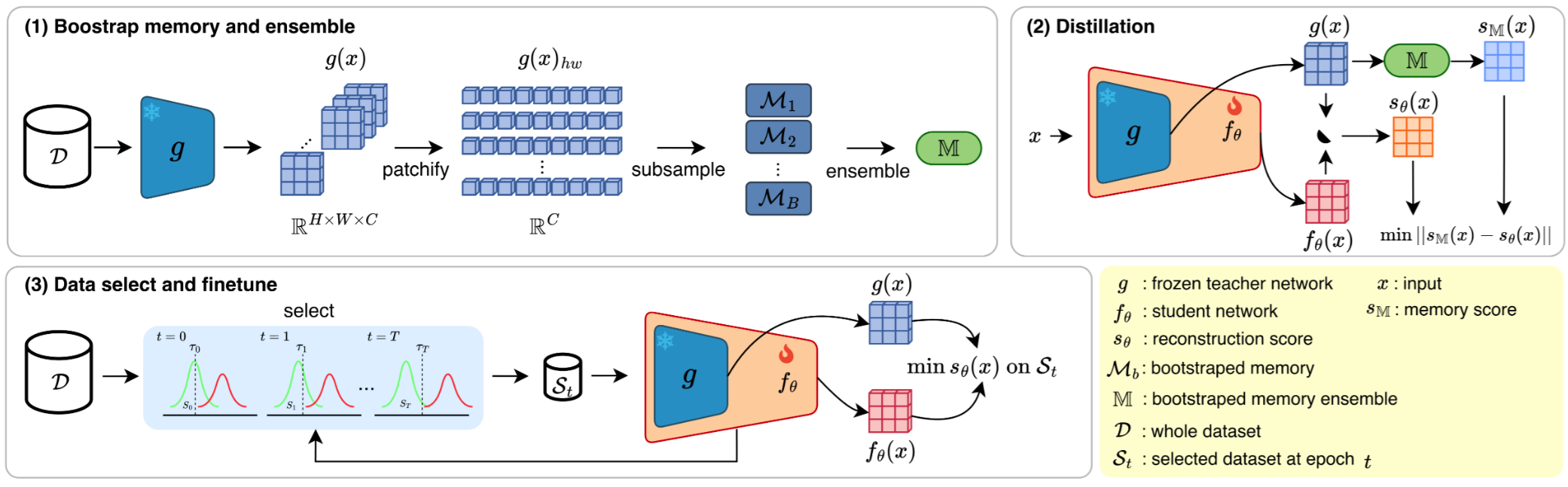
Industrial anomaly detection suffers a significant drop in performance when defect samples are mixed into the training data, and it typically has the limitation of requiring prior knowledge of the noise ratio or separate hyperparameter tuning for each ratio. This paper proposes MeDS, which performs well even without knowing the noise ratio. First, it randomly and sparsely samples memory and ensembles the results; this sparsity acts like a low-pass filter, providing a first-pass separation of normal and defective samples. The resulting scores are then distilled into a reconstruction network, and the model is fine-tuned with the clean data it has filtered out on its own, enabling precise localization down to the pixel level. It remains stable across various noise levels without ratio-specific tuning, achieving an image-level AUROC of 99.16% on MVTecAD with 40% noise and delivering state-of-the-art performance on VisA and Real-IAD as well. As an added benefit, it can also be used as a label correction tool to efficiently identify contaminated samples.
ICML 2026
- Learning with Noisy Label
- Anomaly Detection